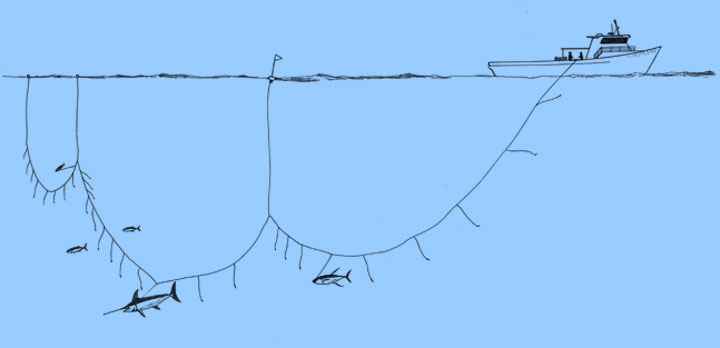
Hawaii’s longline fishery traces its roots back to 1917 when Japanese immigrants introduced “flagline” fishing to Hawaii. Flaglining involved a long mainline made of sections of tarred rope set horizontally in the water, with multiple leaders and baited hooks, suspended by multiple floats with flags; hence the name “flagline”.
Those early vessels were wooden, designed and constructed by Japanese boat builders in Hawaii. Early flagline fishermen depended on native Hawaiians on the island of Hawaii to obtain opelu (mackerel scad) for bait. Some became involved in the flagline fishery.
The number of flagline vessels based in Honolulu and Hilo rose to 42 after World War II but declined to 14 by the late 1970s. The fleet expanded again in the 1980s, reaching 164 vessels in 1991 as modern, long-range steel hull vessels from other fisheries off the mainland U.S. joined the local flagline fleet.
During this period, the flagline vessels converted to modern monofilament mainline, line setters and large hydraulically powered reels. The fishery became known as “longline.”